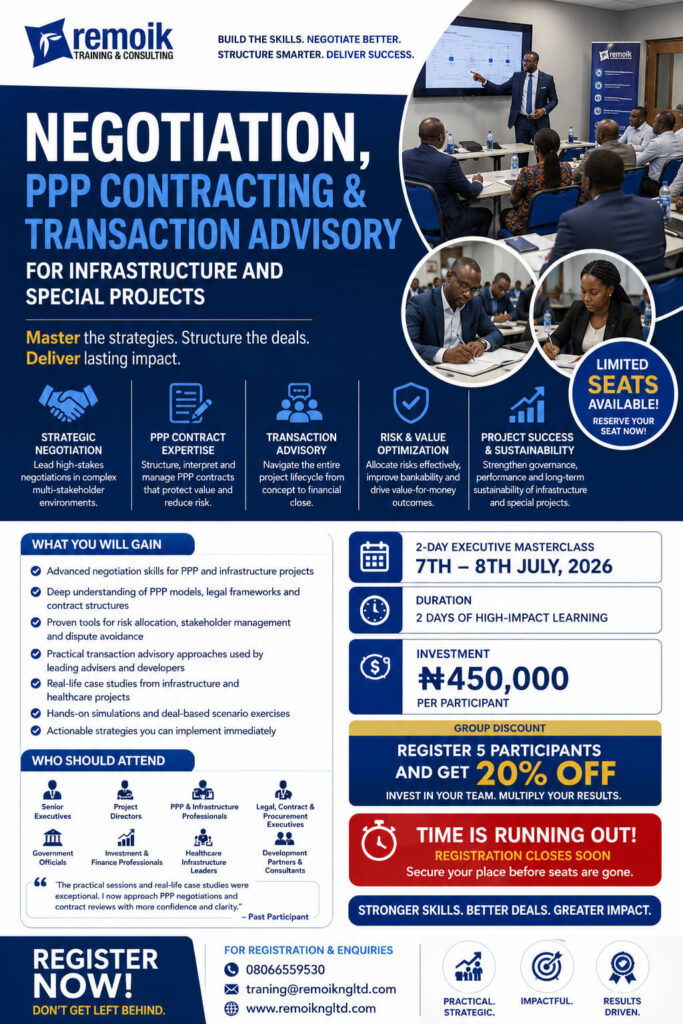
PPP Project Finance, Contract Management & Infrastructure Development Training in Nigeria: Why Every Executive Needs These Skills in 2026
Master Strategic Project Negotiation, Transaction Advisory, Risk Management and Infrastructure Project Delivery
As Nigeria accelerates investments in infrastructure, healthcare, transportation, energy, housing, telecommunications, and public services, the demand for professionals with expertise in Public-Private Partnerships (PPP), Project Finance, Contract Management, Transaction Advisory, and Infrastructure Development has never been higher.
Across both the public and private sectors, organizations are under increasing pressure to deliver complex projects on time, within budget, and in accordance with regulatory and stakeholder expectations. However, many infrastructure projects continue to face challenges such as cost overruns, delayed completion, contractual disputes, financing constraints, poor risk allocation, and ineffective stakeholder management.
The difference between successful and unsuccessful projects often comes down to the quality of negotiation, contract structuring, transaction advisory, and project governance.
This is why forward-thinking organizations are investing heavily in PPP Training, Contract Management Training, Project Finance Training, and Infrastructure Development Training to build internal capacity and strengthen project delivery outcomes.
Why PPP and Infrastructure Development Skills Are Critical in Nigeria
Nigeria’s infrastructure deficit continues to create opportunities for investment across multiple sectors, including:
- Roads and Transportation
- Healthcare Infrastructure
- Energy and Power Projects
- Water and Sanitation Projects
- Housing and Urban Development
- Telecommunications Infrastructure
- Industrial and Economic Zones
- Logistics and Supply Chain Infrastructure
- Education Infrastructure
- Public Service Facilities
To successfully execute these projects, professionals must understand how to structure partnerships, attract investors, manage contracts, negotiate effectively, and mitigate risks.
Organizations increasingly seek professionals who possess practical knowledge of:
- Public-Private Partnership (PPP) Frameworks
- Infrastructure Finance
- Contract Management
- Strategic Negotiation
- Transaction Advisory
- Risk Management
- Project Governance
- Infrastructure Project Delivery
- Stakeholder Engagement
- Project Bankability Assessment
What Is PPP Project Finance and Why Does It Matter?
PPP Project Finance involves the financial, legal, commercial, and operational structuring of infrastructure projects delivered through partnerships between public and private sector entities.
Effective PPP project finance ensures that projects are:
- Financially sustainable
- Attractive to investors
- Commercially viable
- Properly governed
- Legally compliant
- Operationally effective
Organizations with strong PPP capabilities are better positioned to secure funding, manage risks, achieve financial close, and deliver long-term project value.
The Growing Need for Contract Management Professionals
Contract management is one of the most important drivers of project success.
Poorly drafted contracts, weak contract administration processes, and ineffective contract monitoring frequently result in:
- Claims and disputes
- Revenue losses
- Delayed project delivery
- Increased project costs
- Reputational damage
- Regulatory challenges
Through specialized Contract Management Training, professionals learn how to:
- Structure effective agreements
- Interpret contractual obligations
- Manage performance standards
- Monitor compliance requirements
- Resolve disputes proactively
- Protect organizational interests
Strong contract management capabilities contribute directly to improved project outcomes and organizational performance.
Strategic Negotiation: A Competitive Advantage for Modern Executives
Whether negotiating with investors, government agencies, contractors, regulators, development partners, or financiers, negotiation skills have become essential for project leaders.
Successful negotiators are better able to:
- Secure favorable commercial terms
- Build stakeholder consensus
- Manage competing interests
- Reduce project risks
- Improve project viability
- Accelerate decision-making processes
Strategic negotiation is no longer a soft skill—it is a core business capability that directly impacts project performance and organizational success.
Understanding Transaction Advisory in Infrastructure Projects
Transaction Advisory plays a critical role in helping organizations move projects from concept to implementation.
A well-executed transaction advisory process includes:
- Project Feasibility Analysis
- Business Case Development
- Financial Modeling
- Market Sounding
- Procurement Strategy
- Investor Engagement
- Risk Assessment
- Contract Structuring
- Financial Close Support
Professionals trained in transaction advisory are able to guide projects through complex decision-making processes while ensuring alignment between commercial, technical, financial, and regulatory objectives.
Organizational Benefits of PPP, Contract Management and Infrastructure Development Training
Organizations that invest in executive training in these areas can achieve:
Improved Project Delivery
Teams become better equipped to manage project timelines, stakeholder expectations, and implementation challenges.
Better Risk Management
Participants learn practical techniques for identifying, assessing, allocating, and mitigating project risks.
Enhanced Investment Attraction
Projects become more bankable and attractive to investors and development finance institutions.
Reduced Contract Disputes
Strong contract management reduces the likelihood of costly disagreements and litigation.
Stronger Governance and Compliance
Organizations improve transparency, accountability, and regulatory compliance.
Increased Return on Investment
Better project planning and execution lead to improved financial outcomes and long-term sustainability.
Who Should Attend PPP Project Finance and Contract Management Training?
This training is ideal for:
- Chief Executive Officers (CEOs)
- Managing Directors
- Executive Directors
- General Managers
- Project Directors
- Infrastructure Development Managers
- PPP Unit Professionals
- Contract Managers
- Procurement Executives
- Legal Advisers
- Project Finance Professionals
- Investment Managers
- Development Finance Specialists
- Healthcare Infrastructure Executives
- Government Officials
- Regulatory Agencies
- Engineering Consultants
- Construction Professionals
- Public Sector Administrators
Why Choose Remoik Training & Consulting?
Remoik Training & Consulting is committed to delivering world-class executive learning experiences that equip professionals with practical skills and actionable strategies.
Our programmes are designed to bridge the gap between theory and real-world implementation through:
- Interactive Learning
- Real-Life Case Studies
- Negotiation Simulations
- Infrastructure Project Scenarios
- Contract Review Workshops
- Risk Allocation Exercises
- Expert-Led Discussions
- Practical Transaction Advisory Frameworks
Participants leave with tools and techniques that can be immediately applied to their organizations.
Register for the Executive Masterclass
PPP Project Finance, Contract Management & Infrastructure Development Masterclass
Theme: Strategic Negotiation, Transaction Advisory, Risk Management and Project Delivery Excellence
Date: 7th – 8th July, 2026
Course Fee: ₦450,000 Per Participant
Special Corporate Offer
Register 5 participants from the same organization and receive a 20% Group Discount.
Contact Information
Remoik Training & Consulting
Phone: 08066559530
Email: training@remoikngltd.com
Website: www.remoikngltd.com
Seats are limited and registrations will be processed on a first-come, first-served basis.
Invest in the skills required to negotiate better deals, manage contracts effectively, attract investment, reduce project risks, and deliver successful infrastructure projects.
Your next successful project begins with the right knowledge.